

Why Understanding House Furnace Replacement Cost Matters
House furnace replacement cost typically ranges from $3,500 to $11,000, with a national average of around $6,800 for a complete installation. This wide range reflects several key factors that influence your final bill.
Quick Cost Overview:
- Low-End Replacement: $3,000 – $5,000 (basic electric or standard-efficiency gas furnace)
- Mid-Range Replacement: $5,500 – $8,000 (high-efficiency gas furnace)
- High-End Replacement: $8,500 – $11,000+ (premium modulating furnace or complex installation)
The price you’ll pay depends on:
- Furnace type and efficiency rating (AFUE)
- Home size and heating capacity (BTU)
- Labor and installation complexity
- Your geographic location
- Additional features and upgrades
When your furnace fails, it’s more than an inconvenience—it’s a risk to your family’s comfort and safety, with potential for issues like frozen pipes. Whether your furnace is old or needs frequent repairs, understanding replacement costs helps you budget for this crucial home investment. A new furnace is an investment in comfort, safety, and energy savings, as modern units can be significantly more efficient than older models, saving you money on heating bills.
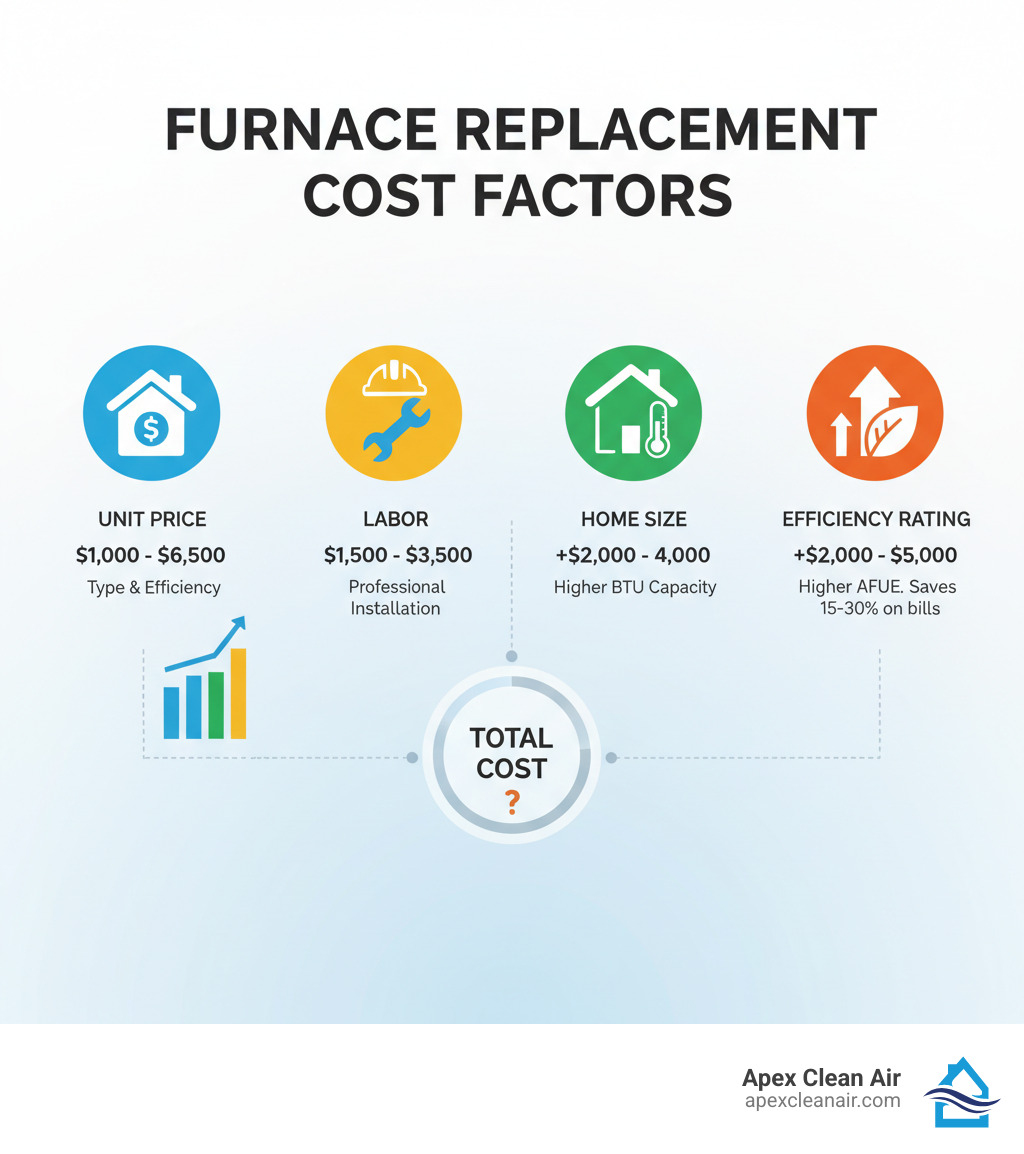
Breaking Down the Average House Furnace Replacement Cost
When you get a quote for a new furnace, the total house furnace replacement cost includes more than just the unit itself. It’s a comprehensive price covering everything needed for a safe and efficient installation.
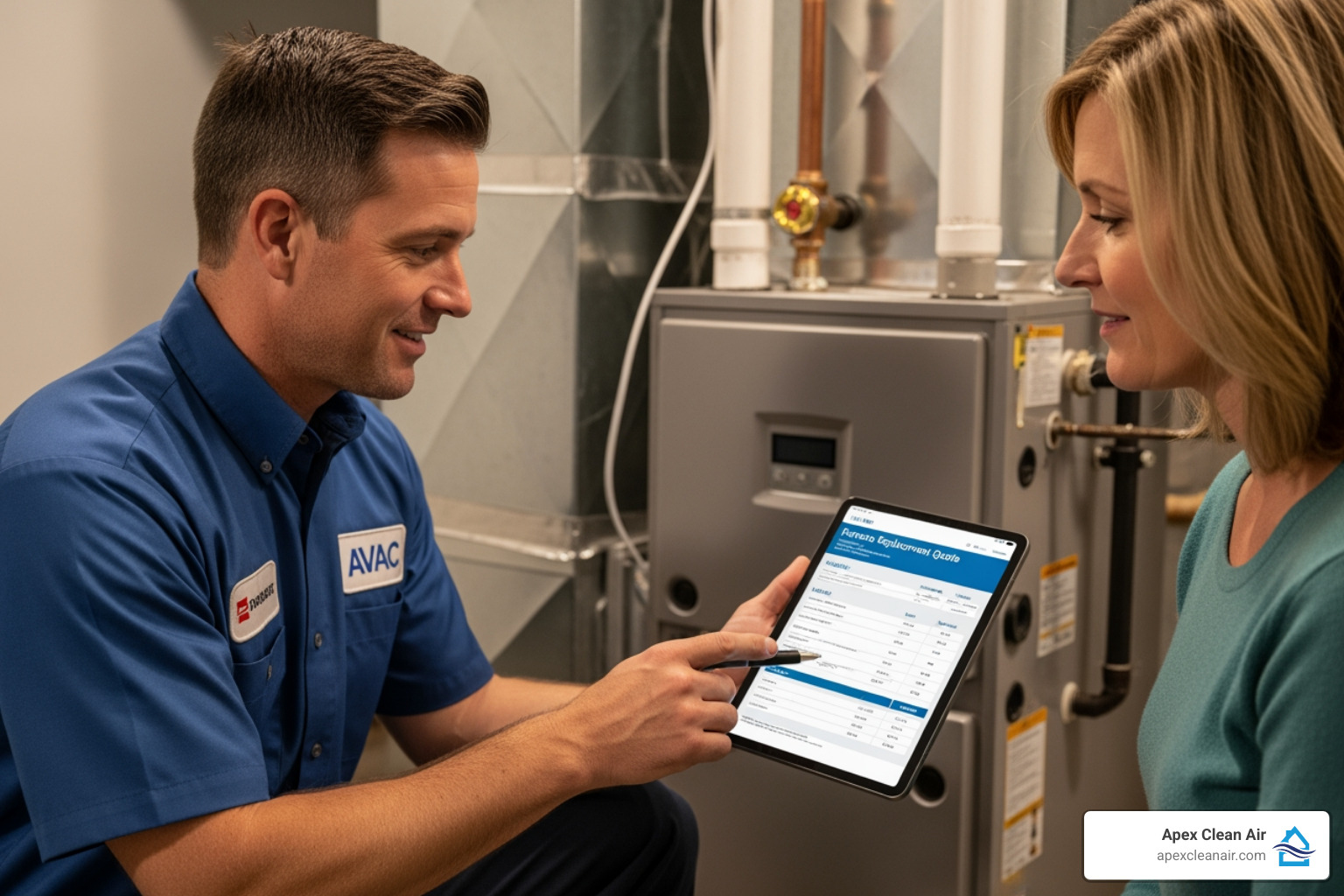
In our service areas across Utah, Colorado, and Idaho, replacement costs generally align with the national average. For example, Denver homeowners might see costs around $4,698, while prices in Salt Lake City, Ogden, and Sandy can vary based on local factors.
Here’s what’s included:
- The Furnace Unit: This is the largest expense, from $1,000 for a basic model to over $6,500 for a top-of-the-line, high-efficiency unit.
- Labor Costs: Professional installation by licensed technicians is crucial. Labor typically accounts for 20-30% of the total bill, covering 4 to 10 hours of work, including setup, connections, and testing.
- Removal and Disposal: We’ll safely remove and dispose of your old furnace, which can add $50 to $330 to the cost.
- Permits and Inspections: Required by law for safety, these fees range from $50 to $1,500, depending on your municipality. We handle all the paperwork for you.
- Geographic Location: Local labor rates, transportation, and building codes in areas from rural Idaho to downtown Denver can influence the final price.
Professional installation is non-negotiable. A furnace involves complex electrical and gas line work. A mistake can void your warranty, create safety hazards like gas leaks, or cause electrical fires. Our certified technicians ensure your installation is safe, efficient, and up to code.
How Home Size and Furnace Capacity (BTU) Impact Cost
Your home’s size directly influences the required furnace capacity, measured in British Thermal Units (BTUs). A BTU is a unit of heat, and a furnace’s BTU rating indicates its heating power. Most homes need 30-60 BTUs per square foot. For a 2,000 sq. ft. home, that’s a 60,000 to 120,000 BTU furnace.
However, factors like your climate zone, insulation, and window quality are critical. Homes in Utah, Colorado, and Idaho need more heating power than those in warmer climates. Our technicians perform a detailed load calculation to determine the perfect size for your home. For general background, the U.S. Department of Energy provides a helpful overview of furnace sizing and efficiency basics.
- Oversizing causes the furnace to cycle on and off frequently, leading to wasted energy, uneven heating, and premature wear.
- Undersizing means the furnace runs constantly without ever reaching the desired temperature, especially during cold snaps.
Getting the size right is key. As capacity increases, so does the price. A furnace for a 1,000 sq. ft. home might cost $1,200-$2,000, while one for a 3,000 sq. ft. home could be $3,600-$6,000 or more for the unit alone.
The Role of Efficiency (AFUE) in Upfront and Long-Term Costs
When considering house furnace replacement cost, efficiency—measured by the Annual Fuel Utilization Efficiency (AFUE) rating—is crucial. AFUE tells you how much fuel is converted to heat. An 80% AFUE furnace wastes 20% of its fuel.
The federal minimum for new gas furnaces is 80% AFUE. Here’s how the tiers break down:
- Standard-Efficiency (80-89% AFUE): Installed cost of $3,800 – $6,200.
- Mid-Efficiency (90-95% AFUE): Installed cost of $5,200 – $8,800.
- High-Efficiency (96%+ AFUE): Installed cost of $7,500 – $12,000.
Higher efficiency means a higher initial price, but it also means significant long-term savings. Upgrading from an old 60% AFUE unit to a 95% AFUE model can cut your heating bills by up to 30%. In cold climates like ours, the monthly savings can quickly offset the higher upfront investment, making a high-efficiency furnace a smart financial choice. If you’re exploring incentives, review current ENERGY STAR federal tax credits for furnaces.
Comparing Furnace Types and Features
The type of furnace you choose profoundly impacts your house furnace replacement cost, both initially and over its operating life. The right choice depends on your home, budget, and local fuel availability.
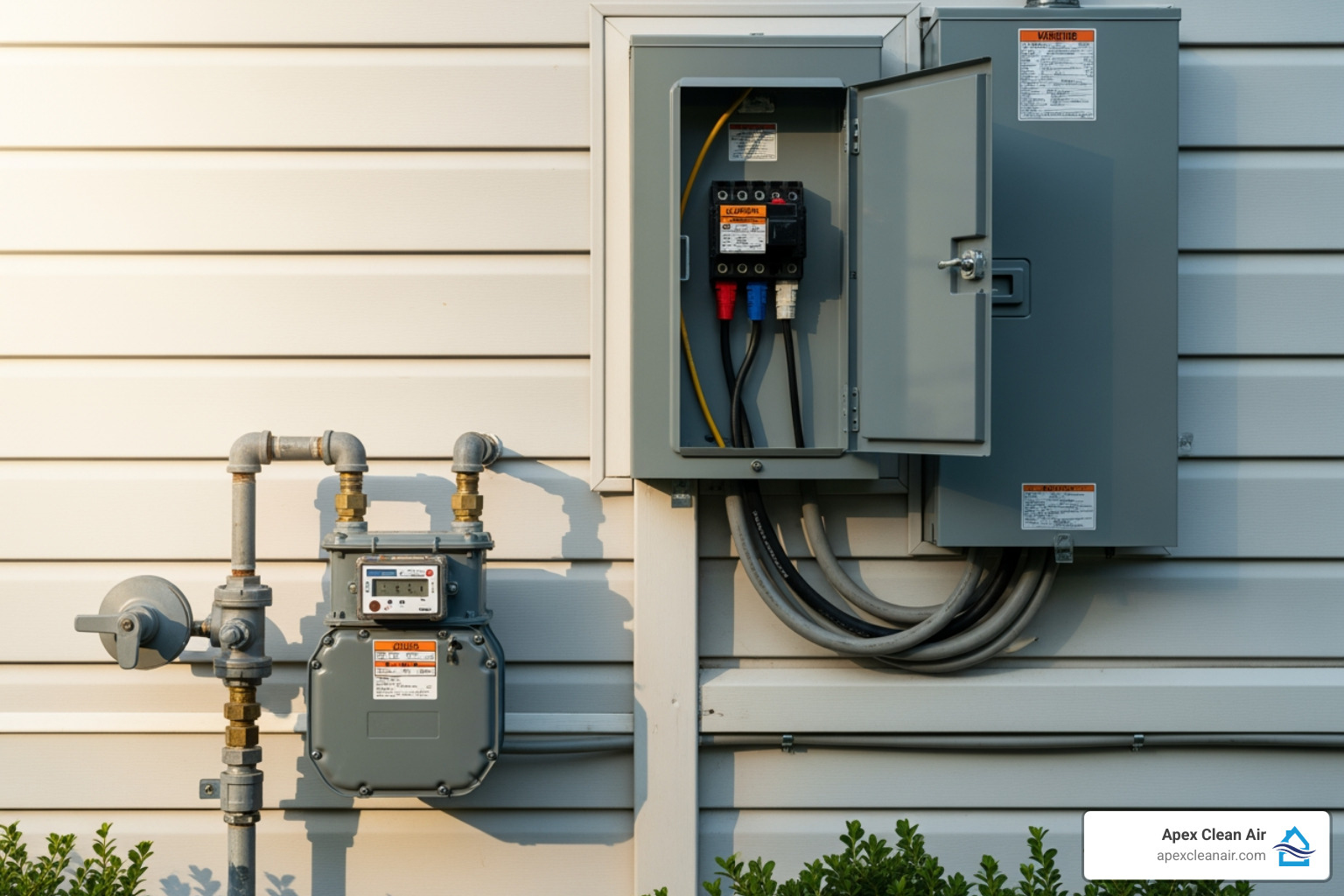
When helping you select a new furnace, we consider upfront costs, long-term operating expenses, and the system’s lifespan. In our service areas of Utah, Colorado, and Idaho, natural gas is widely available and often the most economical choice. Electric furnaces are an option everywhere, while oil and propane are common in rural areas without natural gas lines. Gas furnaces typically last 15-20 years, while electric models can last 20-30 years due to fewer moving parts.
Understanding the House Furnace Replacement Cost for Different Furnace Types
Let’s break down the most common furnace types:
| Furnace Type | Average Installed Cost | Pros | Cons |
|---|---|---|---|
| Natural Gas | $3,800 – $10,000 | Most popular and cost-effective to operate; reliable heat output; widely available in urban areas; long lifespan (15-20 years); high-efficiency models available | Requires gas line connection; professional installation mandatory; potential carbon monoxide risk if not maintained; higher upfront cost than electric |
| Electric | $2,000 – $7,000 | Lower upfront cost; easier and safer installation; no combustion means no carbon monoxide risk; longest lifespan (20-30 years); nearly 100% efficient at point of use | Higher operating costs in most areas; slower heat-up time; can struggle in extremely cold climates; may require electrical panel upgrade |
| Oil | $4,500 – $9,000 | Effective in areas without natural gas; produces very hot heat; reliable in extreme cold | Highest operating costs; requires on-site fuel storage tank; more maintenance required; environmental concerns; becoming less common |
| Propane | $3,700 – $10,500 | Good option for rural areas; cleaner burning than oil; portable fuel source | Requires tank rental or purchase; fuel delivery needed; higher operating costs than natural gas; price volatility |
Natural gas furnaces are the top choice in the Salt Lake City, Denver, and Boise metro areas, offering a great balance of cost and efficiency. Electric furnaces are simpler and have a longer lifespan, making them suitable for smaller homes or areas without gas, especially if paired with solar panels. Oil and propane furnaces serve rural homes where natural gas is unavailable, but they require on-site fuel storage and have higher operating costs.
Single-Stage, Two-Stage, and Modulating Furnaces
Beyond fuel, furnaces vary in how they produce heat, which affects comfort, noise, and your house furnace replacement cost.
Single-Stage Furnaces: These are the most basic, operating on an all-or-nothing basis. They turn on at 100% power and then turn off, which can create temperature swings and more noise. They are the most affordable option, costing $500-$1,500 less than advanced models.
Two-Stage Furnaces: A significant upgrade, these units have a low (e.g., 65%) and high (100%) setting. They run on the lower, quieter, and more efficient setting most of the time, providing more consistent heat. This is often the best balance of cost and comfort, typically adding $1,000-$2,000 to the price.
Modulating Furnaces: The premium choice, these furnaces adjust their heat output in small increments, like a dimmer switch. This provides the most precise temperature control, quietest operation, and highest efficiency. The superior comfort and quietness come at a higher price, adding $2,500-$5,000 to the total cost compared to a single-stage unit.
Key Factors Influencing Your Furnace Investment
As we’ve seen, the final house furnace replacement cost is not a single number but a combination of factors. The type and efficiency of the unit, the size of your home, and the complexity of the installation all play a crucial role. Making an informed decision means balancing the upfront investment with long-term energy savings and home comfort.
A Closer Look at Cost Components
When we talk about the overall house furnace replacement cost, we’re not just looking at the price tag of the furnace itself. Several components contribute to the final bill. Understanding these elements helps you get an accurate estimate with no surprises.
In our service areas like Denver, Salt Lake City, and Boise, costs are influenced by local market conditions. Here’s a summary of the main cost components:
- Furnace Unit Cost: The price of the equipment, which varies by type, brand, and efficiency.
- Labor Costs: Charges for skilled technicians to perform the installation, which can take 4 to 10 hours.
- Removal and Disposal Fees: The cost to safely remove and dispose of your old unit.
- Permit and Inspection Fees: Required by your municipality to ensure safety and code compliance.
- Sizing (BTU) & Efficiency (AFUE): The capacity and efficiency rating of the furnace significantly impact both the upfront price and long-term operating costs. A professional load calculation is essential to avoid the problems of an improperly sized unit. While online calculators can offer a rough idea, we always recommend a professional assessment for precise sizing.
- Professional Installation Necessity: We cannot stress this enough: furnace installation is not a DIY project. It involves complex systems and potential hazards. Our certified technicians ensure your new furnace is installed correctly, safely, and efficiently.
Comparing Furnace Types and Features
The type of furnace you choose profoundly impacts your house furnace replacement cost, both initially and over its operating life. Different fuel sources come with their own set of advantages and disadvantages, from upfront cost to long-term operating expenses and fuel availability in your area.
Understanding the House Furnace Replacement Cost for Different Furnace Types
Here’s a comparison of the most common furnace types to help you understand your options:
| Furnace Type | Average Installed Cost | Pros – Cons – | |
|---|---|---|---|
| Natural Gas | $3,800 – $10,000 | Most popular and cost-effective to operate; reliable heat output; widely available in urban areas; long lifespan (15-20 years); high-efficiency models available | Requires gas line connection; professional installation mandatory; potential carbon monoxide risk if not maintained; higher upfront cost than electric |
| Electric | $2,000 – $7,000 | Lower upfront cost; easier and safer installation; no combustion means no carbon monoxide risk; longest lifespan (20-30 years); nearly 100% efficient at point of use | Higher operating costs in most areas; slower heat-up time; can struggle in extremely cold climates; may require electrical panel upgrade |
| Oil | $4,500 – $9,000 | Effective in areas without natural gas; produces very hot heat; reliable in extreme cold | Highest operating costs; requires on-site fuel storage tank; more maintenance required; environmental concerns; becoming less common |
| Propane | $3,700 – $10,500 | Good option for rural areas; cleaner burning than oil; portable fuel source | Requires tank rental or purchase; fuel delivery needed; higher operating costs than natural gas; price volatility |
Natural gas is the most common and economical choice in our service areas. Electric furnaces are a good alternative where gas is unavailable, offering a lower upfront cost. Oil and propane are viable for rural homes but typically have higher operating costs and require on-site fuel storage.